From complex microstructures
to reliable data of your products
Typical use cases: the measurement problem, our direct microforce-based approach, and the data you end up with.
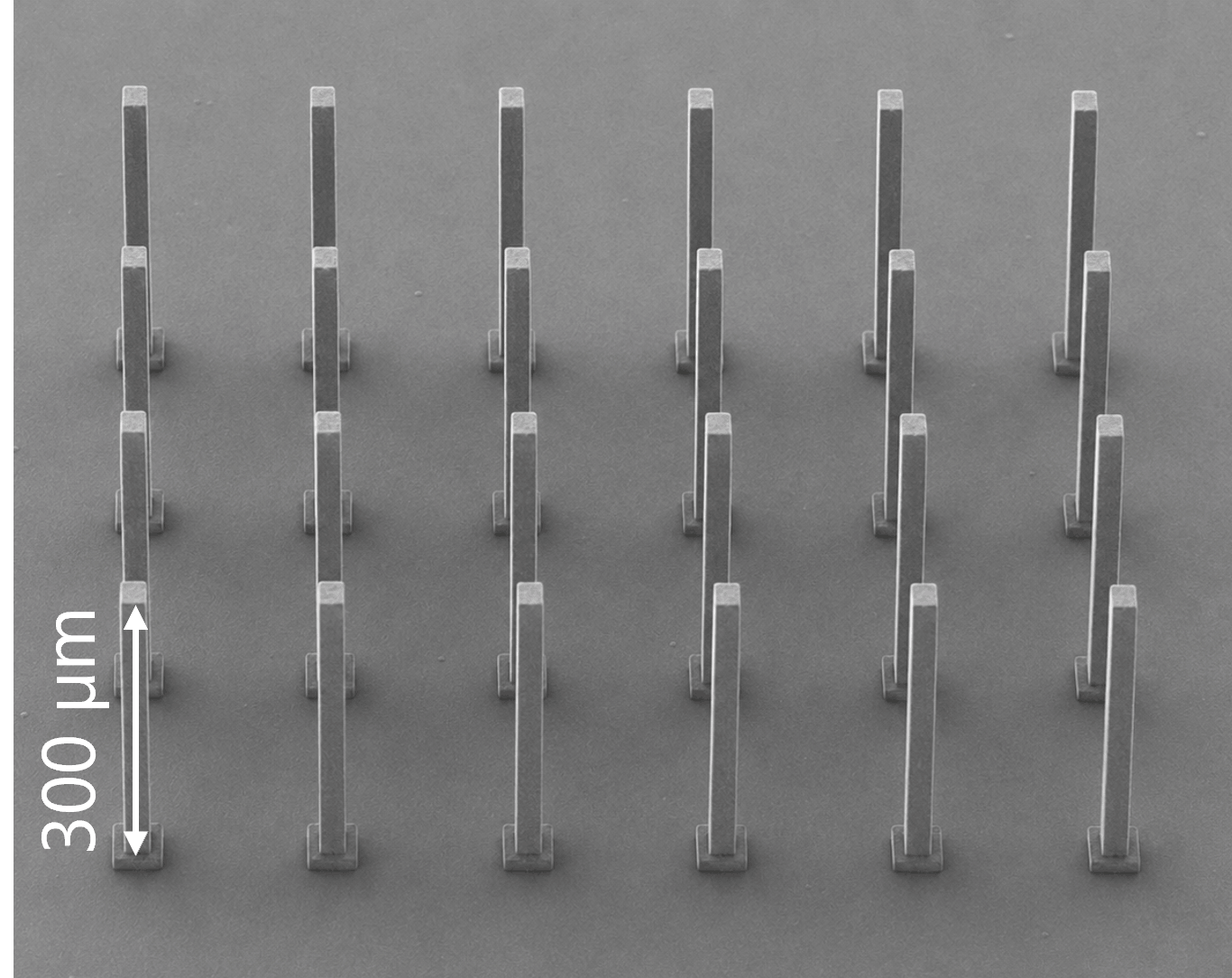
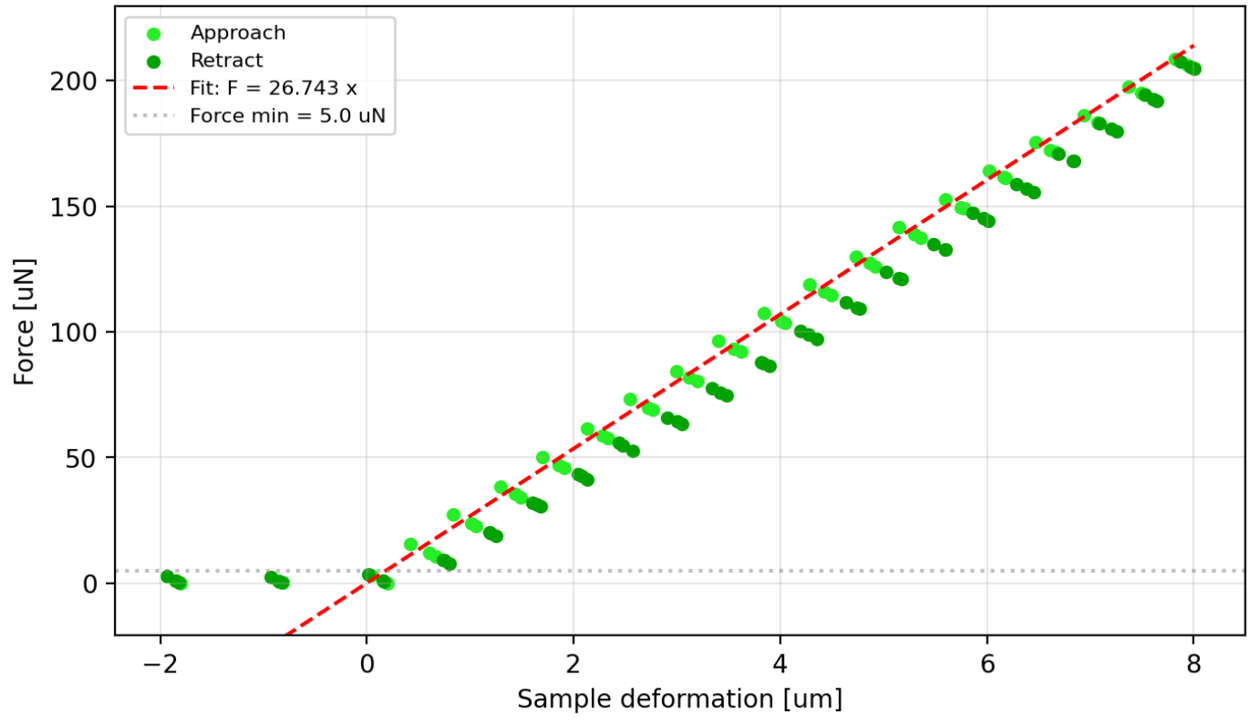
Two-photon polymerization (2PP) microstructures
Problem
Microstructures printed by two-photon polymerization (2PP) are often too small, too soft, too fragile or geometrically too specific for conventional mechanical characterization tools.
SensiTips approach
Microforce sensors with adapted stiffness and a contact strategy defined for your geometry generate reliable force-displacement data on microbeams, micropillars and similar microstructures.
Measured outputs
- Stiffness
- Young's modulus
- Viscoelastic behavior
- Repeatability across structures
- Comparison between fabrication parameters
Value
Researchers obtain data suitable for publications. R&D teams obtain quantitative mechanical feedback that reduces trial-and-error loops during microstructure development.
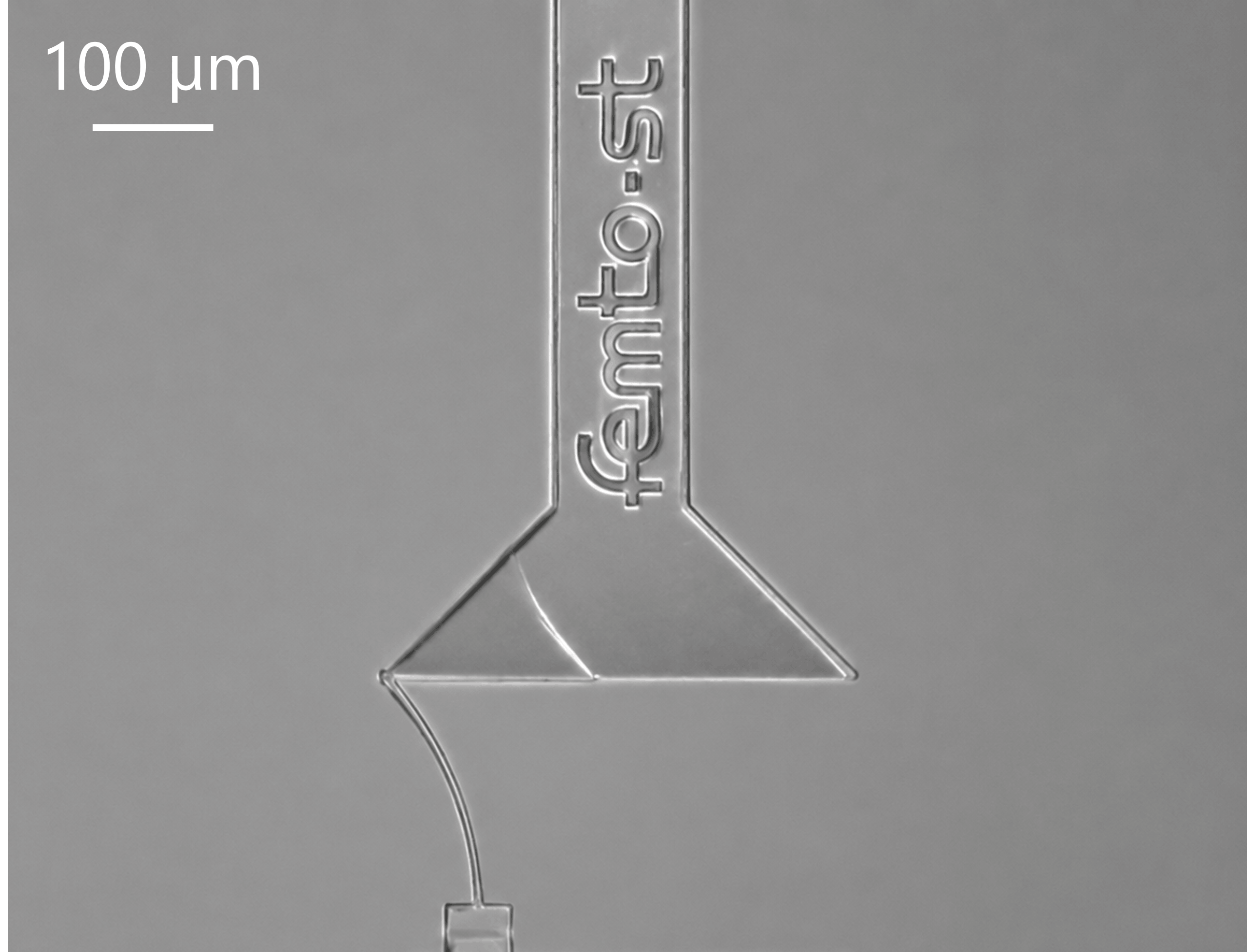
Microbeams and micropillars
Problem
Bending an isolated microbeam or compressing a micropillar requires applying the force at the right point, along the right axis, without damaging the structure — something standard instruments rarely allow.
SensiTips approach
The sensor, its tip and its loading axis are chosen to match the structure's geometry. Bending and compression tests produce force-displacement curves directly linked to the structure's mechanical model.
Measured outputs
- Bending or compression stiffness
- Modulus extracted from the geometric model
- Behavior up to high forces when needed
Value
Data that validates — or invalidates — a design or a numerical model before committing to the next development step (R&D) or quality control (production).
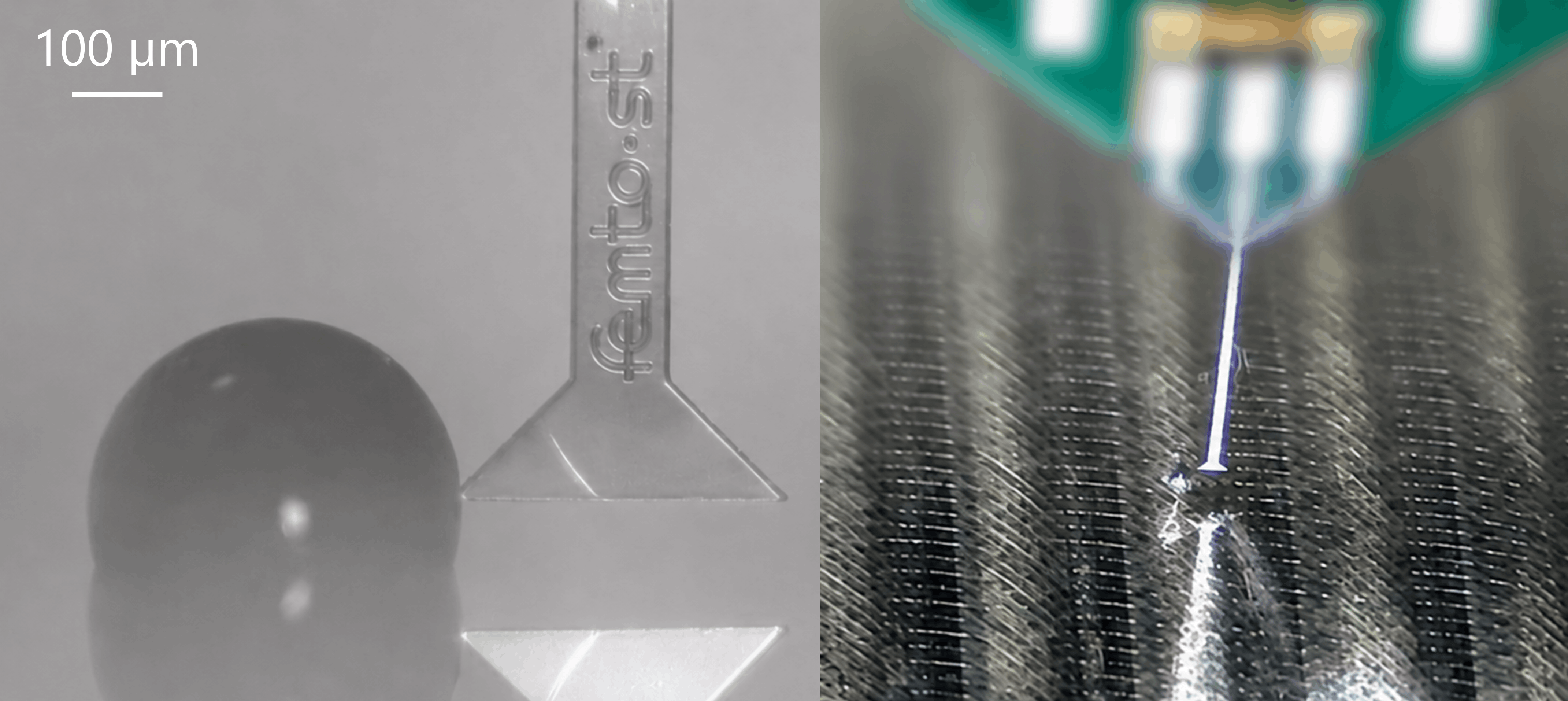
Soft micro-objects
Problem
Hydrogels, elastomers, soft polymer structures: very low stiffnesses demand tiny measurement forces — otherwise you crush the object instead of characterizing it.
SensiTips approach
Low-stiffness sensors (from 1 N/m) with nanonewton resolution apply controlled loads matched to the object's softness, in quasi-static as well as cyclic testing.
Measured outputs
- Stiffness and apparent modulus
- Viscoelastic behavior (creep, relaxation, hysteresis)
- Repeatability across samples
Value
Quantified mechanical properties on materials that classical nanoindentation struggles to characterize.
Micro-actuators
Problem
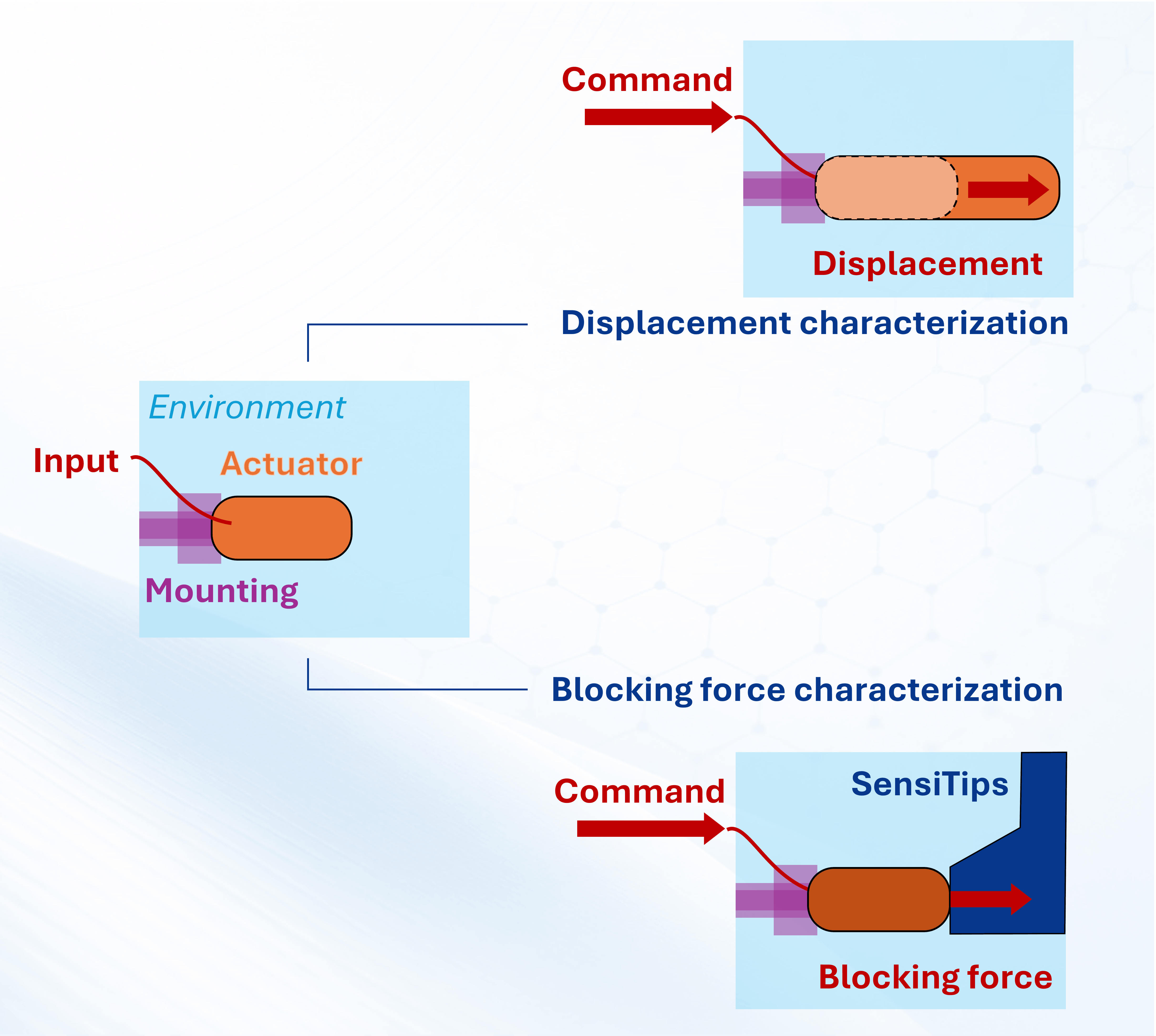
How much force does your MEMS or actuator really generate? Models give an estimate — experimental validation requires a direct force measurement, at the right contact point.
SensiTips approach
The sensor is positioned in contact with the actuator and measures the generated force as a function of command, displacement and time.
Measured outputs
- Generated force vs command
- Actuator force-displacement characteristic
- Gap between model and measurement
Value
Experimental validation that consolidates the model and de-risks the next design iterations.
Process validation, quality control and advanced materials
Problem
A change of process, in your tests or in production, alters the mechanical properties — but by how much? Without measurement, development proceeds blindly or your production can diverge.
SensiTips approach
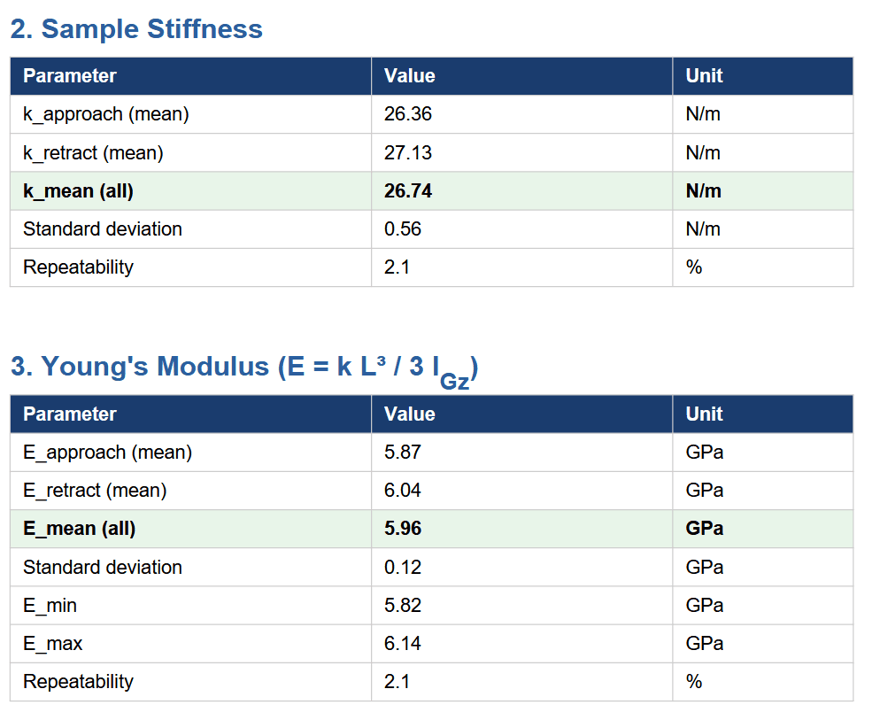
Comparative measurement campaigns, with a constant protocol, quantify the effect of each process parameter on stiffness, modulus or viscoelastic behavior.
Measured outputs
- Quantitative comparison between parameters
- Process repeatability indicators
- Process → mechanical-properties mapping
Value
Less trial-and-error, data-driven process choices, and a solid technical file for your customers or reviewers.
Your case is not listed?
If your sample is too small, too soft, too fragile or geometrically complex for your current instruments, chances are we can characterize it. Tell us about it.